Description
Antiquarian maps from the 18th and 19th centuries further reveal an intricately Europeanised town, though segregated between Europeans and Indians, featuring a shared use of motifs and style. The arrival of commercial photographers Bourne and Shepherd, or indeed the mysterious French photographer C. (possibly Charles) Moyne, brings forth an expansive city of citadels and churches, with broadening boulevards lined with trees.
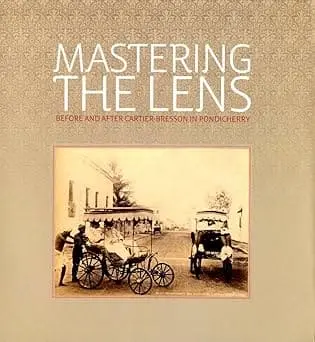
This publication emanates from an exhibition by the same title. It is an attempt to trace the development of photography with some of the other allied visual documents arising from Pondicherry, spanning the late 19th and early 20th centuries. Drawn exclusively from The Alkazi Collection of Photography, at the core of this initiative is the unpublished album by renowned photographer Henri Cartier-Bresson, co-founder of Magnum Photos, who visited Sri Aurobindo Ashram in April 1950. He took the last pictures of Sri Aurobindo Ghosh in the company of his spiritual companion, ‘the Mother’. In addition, he meticulously penned his observations, creating a meta-text around the images, which presents a biographical and anecdotal supplement to his photographic endeavour.
The visual material is further complimented by some extraordinary images taken by Indian practitioners from the same period such as Tara Jauhar and Venkatesh Shirodkar at Sri Aurobindo Ashram, published here for the first time. A conscious effort has been made to reveal a non-linear, yet credible visual history of Pondicherry—how it has been witness to the development of a unique photo-graphic history. The use of images as ‘evidence’ and ‘document’ create a subtle interplay between cultural context and artistic intent, a conceptual linking of mannerisms and tropes—those of landscape, architectural and portrait photography.
Explore more from our collection.



Reviews
There are no reviews yet.